Sunday, June 19, 2022

Tru-Vue

While stereographic (3-D) photography dates back nearly 200 years, it wasn’t until the introduction of Tru-Vue that the format became more streamlined and compact, as it utilized film rather than prints to create the stereo view.  Throughout the 1940s and 1950s subjects were primarily scenes of a travel-related or educational nature, although other scenes based on popular comic strips and comic books were available too such as Blondie, Buck Rogers, and Captain Marvel.  As  they continued to add more subjects geared towards children, titles expanded to include Disney, Howdy Doody, Red Ryder, and other western subjects.


In 1950 Tru-View began producing color films for the first time, partly in response to Sawyer’s competing View-Master product, which had been in color since its 1938 introduction.  The color process selected by Tru-Vue was Ansco, which at the time was more economical than Kodak and provided the needed color reproduction demanded by Ford Motor Company for its promotional film strips.  However Ansco color is not very stable and most films turned magenta over the years, the exception sometimes being cartoon subjects.


Tru-Vue acquired its Disney license in 1950 and held it through 1956.  At the time Tru-Vue was in the process of transitioning from black & white to color, so titles would sometimes appear in both formats. 
 

The Alice films were sold during the original release of the film in 1951, during not only the transition from black and white to color, but also from Tru-Vue’s Rock Island plant to Sawyer’s Beaverton plant.  When one compares the product information contained in the Character Merchandise Division catalog with the actual products themselves, you can see the transition as the company is list in Rock Island in promotional material but Beaverton on product packaging.  One can only imagine the the logistical nightmare of manufacturing, marketing, and selling Alice and all the other products during this time.


The black & white Film (B 51) was issued with the standard red and white box, the black and white film consists of ten scenes, down from the original 14 scenes in the pre-color days.  The films are a little difficult to look at these days, as the intervening 70+ years tightly wound in their little boxes makes them act like watch springs, recoiling violently with the slightest misstep in handling them.


The color film (X 51) was issued in the standard red, yellow, and blue box, the color film consists of the standard nine scenes.  

Both the black & white and color sets consist of the four sequentially numbered Disney films:  Alice in Wonderland (51), Bambi (52), Donald Duck (53), and Mickey Mouse (54) in an illustrated box featuring Donald Duck holding a Tru-Vue viewer.


Thursday, May 5, 2022

Zaccagnini Auction Result!

Today an amazing collection of Zaccagnini figures was auction, including a King of Hearts!  The result of the auction were mixed, but the king did especially well, realizing 6x his original high estimate.  Congratulations to the winner, he is indeed exceptionally rare.


Tuesday, February 22, 2022

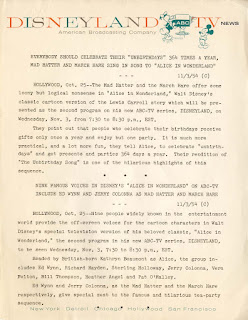
ABC Press Release for Disneyland TV Show "Alice in Wonderland" Premiere - October 25th, 1954

Now this is the kind of thing that I just love.  In 1954 Walt Disney created the Disneyland TV show to promote the upcoming Disneyland theme park.  The show premiered on October 27, 1954, and featured Walt talking all about the park under construction.  An historic event, the first episode of a weekly Disney television show.  But, the second episode was just as much of an historical event as it featured the very first time a Walt Disney feature film was broadcast on television, and that film was "Alice in Wonderland."
This press release is dated two days before the series premiere and details the second episode featuring Alice.  It is comprised of three separate 'stories' that could be used to promote the show.  I especially love the letterhead featuring Donald behind the television camera.
The "Alice" episode was broadcast on Nov 3, 1954 and was heavily promoted, even the TV guide from that week had an extra large listing for the show!


Monday, February 21, 2022

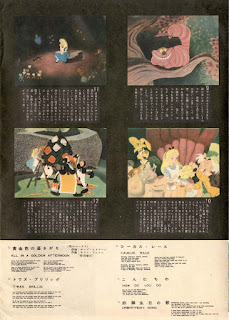
RKO Program from Japan 1953

Japan is one of the few countries to release Alice several years after its premiere, 1953 to be exact.  But that doesn't mean they did not have RKO promotional material.  This is one such item, an eight-page program - and one that I had never seen before until recently.

Original release items from Japan are quite difficult to come by, so I was thrilled to acquire this piece.  And I was surprised at how large it is, fully 8 1/2" x 12", which corresponds (most closely) with the standard size kiku 4.

The cover features some art we've seen before, that of the "Up to the Minute News" sheet of legal-sized paper I wrote about here, with an inset of Alice and the Broom Dog from the Tulgey Wood.  Even in 1953 the Japanese were ahead of their time highlighting unusual characters.

The remainder of the program (90% in Japanese) features character blurbs with photos of the actors, and a synopsis of the story with song lyrics to boot.  All in all a fabulous piece.


Thursday, February 3, 2022

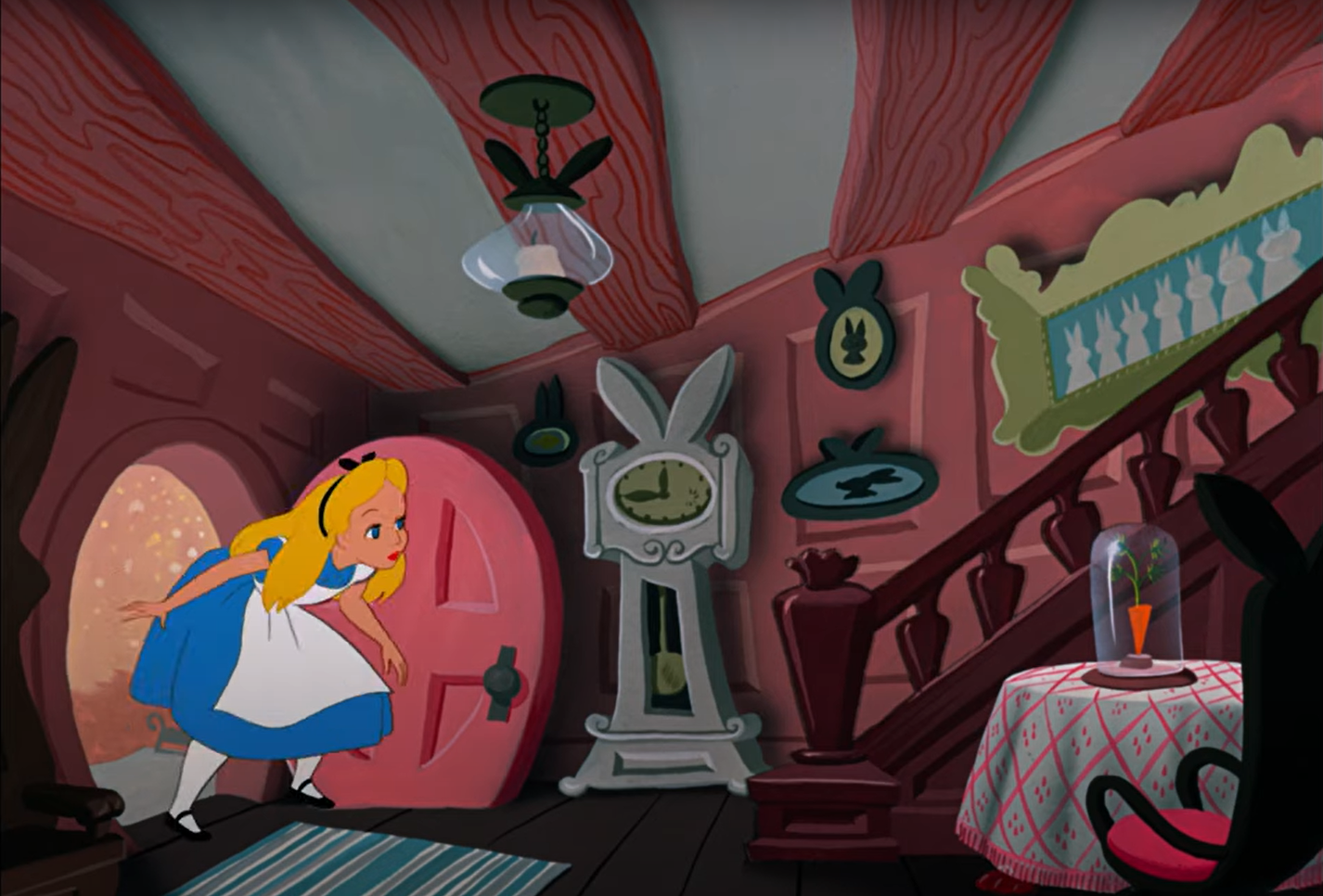
Storyboard of Alice in the White Rabbit's House

 There's been a lot of activity here in the Tulgey Wood these past few weeks.  Work has been creeping along to get the collection room back into shape, and that means that I've been through every storage bin and portfolio as we decide what stays and what goes.  We've also started using the gargantuan flat file we purchased about 5 years ago, now as a staging area and eventually as a final home for some of the larger paper thing like posters and large art.  

To that end, I've uncovered some art that hasn't seen the light of day in quite some time, including this wonderful painted storyboard of Alice entering the front door of the White Rabbit's house in search of his gloves.  It is unclear who the artist is, way back in the 1990s it was shopped around as Mary Blair, but I'm not sure about that.  Regardless it is a great piece with lots of very nice details.  I especially love the rabbit family portrait headed up the stairs.

I must say the finished film matches quite well with this concept piece, although the 'carrot under glass' in the film is a better visual gag than the 'roses under glass' in the concept.  


Tuesday, January 11, 2022

Ringing in the New Year!

 It's a new year and changes are a happenin' here in the Tulgey Wood.  We are finally getting back to flood recovery, and have now successfully made our first pass at the contents of all the storage bins.  Next phase is to rebuild all the displays - no mean feat, especially with a nationwide lumber shortage!  But fear not, I will continue to post things as I find time, and give updates on the progress with the book.  Which I'm happy to say is continuing.  I'm well into the second chapter "Toys, Games, & Puzzles" and have uncovered a few interesting bits related to them.

So let's start off with something newly acquired this year:  This super cool set of kokeshi dolls from Japan, probably 1960s or early 1970s.  Not quite within my usual time period, but I have a very soft spot for kokeshi dolls.


Alice and the White Rabbit have the traditional wobbly heads, but the cards are static.  According to the person I got them from, they are by a company called Senshukai, which is still in business today!  Their first kokeshi dolls were made in 1954, but I'm not sure when they acquired a Disney license.


Thursday, November 25, 2021

Happy Thanksgiving!

 To everyone in the US, a very happy Thanksgiving, and may your turkey be more appetizing than this one!


Monday, August 30, 2021

Model Sheet of Alice from February 1950 - a Recent Addition!

Over the years I've been very successful in finding model sheets of many of the characters from the film, including some very odd ones indeed.  And as one might expect, there were several of Alice herself.  But for the past 32 years one of the Alice sheets has eluded me, but no longer!  Sheet 250-7 is finally in the collection!

This sheet has a couple of very famous poses, most - if not all - taken from the Caterpillar sequence.  The central image is of Alice leaning on the mushroom listening raptly to the Caterpillar, and the image just below it is of Alice saying "...who you are first?"  Feels good to finally have this sheet after so many years.


Thursday, August 12, 2021

Sunday News September 9, 1951

This is truly spectacular.  This is a copy of the Sunday News, the Sunday supplement of the New York Daily News from September 9, 1951.  That in and of itself is not that spectacular, even though it does have a very nice cover featuring Anne Francis of Forbidden Planet and Honey West fame.

No, the spectacular part is on the very next page, the inside front cover to be exact, which sports - in glorious full-color rotogravure - an amazing photo of Kathryn Beaumont speaking animatedly to her Wonderland friends in doll form.  I do find it amusing that whoever wrote the caption got the two rabbits mixed up.

These dolls have appeared before in several black and white photos, and while it is never clear what exactly they are, it now seems UN-likely that they are Lars of Italy (thanks to the keen eye of uber collector Mel Birkrant).  They could be custom made just for the studio or even by the studio, but regardless, this is just an amazing image.  And a rare full color image from the time.


Wednesday, July 28, 2021

70th Anniversary of the US Premiere

 Yes, that's right, the world premiere was 2 days before the US premiere.  Walt was doing a big push in the UK what with having so many productions active over there using up money in limbo.  So a great excuse for a big 'do across the pond.  But that doesn't mean interesting things didn't happen back here in the US.  Here are two items that are favorites in the collection, both have been posted before, but I think they deserve another day in the spotlight.  First up is a press preview ticket for the film, a full month before the premiere!


This is such a cool piece of ephemera, something that the studio would have mailed to various publications so they could review the film prior to release.  It is amazing things like this survive at all, means that whomever received it didn't go!  My thanks to you, unnamed press guy.

Next is a studio preview ticket, for 2 weeks before the premiere.  Again, the only reason this survived is they didn't go!  Which I find hard to believe.  Wouldn't you go to a preview of the most hotly anticipated film from the studio in ages if you could?


I owe a particular debt of gratitude to John Koukoutsakis for this post.  


Monday, July 26, 2021

70th Anniversary of the World Premiere in London

 I would be very remiss indeed if I let today go by without a post, it's not everyday one turns 70 after all!  Today we have a copy of the UK Photoplay magazine from August 1951, with a cover of Esther Williams looking quite fetching.  But the real gold is inside.

A four-page full color illustrated article on the film.  And while the illustrations are just frames from the film, the design is amazing!
Telling the story via this series of stills as if they were taken directly from the 35mm film is quite charming indeed.
And this was apparently a popular article.  It is the two centerfold wraps of the magazine, and this issue is often found with these four page missing.  People had good taste!