Tuesday, April 18, 2023

Luton Girls Choir Medley from Alice in Wonderland (with a friend)

As many of you know, I'm deep into the writing of the book, and part of that involves a LOT of scanning.  The past few weeks have been consumed with the scanning of seemingly endless records of various sizes, speeds, and countries.  Perhaps the most interesting re-discovery is this recording of the Luton Girls Choir singing a medley of songs from Alice, with I'm Late sung by "a friend," who has so far not been identified.  Give it a listen and if you know the singer let me know in the comments!


Thursday, February 23, 2023

Mettoy Mad Hatter's Race Game

Here is a preview of the section on the Mettoy Mad Hatter's Race game from the forthcoming book.  Enjoy!

--

Founded in 1933 by Jewish emigrants fleeing the Nazis, Mettoy (a contraction of METal TOY) made a metal, tin, and plastic toys over a span of fifty years.

Arthur Katz was born in Johannesburg, South Africa in 1908.  When his father died in 1920 he moved to Nuremberg with his mother since she was originally German.  After completing school he entered the toy business as an apprentice for a toy export company.  Once his apprenticeship was complete he began working for a tin toy company, Tipp & Co, which was owned by a cousin Philip Ullmann.

With the rise of the Nazis in 1933, he emigrated to England on his South African British passport.  Ullmann joined him shortly thereafter, and the two formed a new toy company, Mettoy, in a workshop owned by a model train maker, Basset-Lowke.  But within five years they has to switch from tin toys to war production as England entered World War II.  Interestingly their landlord Basset-Lowke had a vested interest in many Jewish-German suppliers for their business, and that company spent a large portion of their profits helping Jewish refugees escape Germany.  

The war and accompanying defense contracts were good to Mettoy, so much so that the company needed to expand into a larger manufacturing space, which was arranged by the British government.  The new factory was in Swansea, Wales in the town of Fforestfach.  When the war ended in 1945, toy production resumed.  By this time Mettoy had expanded into plastics given that rationing of metal was still in force, but by 1956 rationing had been lifted and they began making their most well known toy line of all:  Corgi die cast vehicles.  

Throughout the 1950s and early 1960s Mettoy continued to grow with Corgi sales increasing in their standard car line but especially so with their licensed cars for Batman, James Bond, and Chitty Chitty Bang Bang.  However, the arrival of Mattel's Hot Wheels in the late 1960s, coupled with a devastating fire in at the factory in 1969, Mettoy's fortunes began to turn.  The 1970s and 1980s were a difficult time for Mettoy, and despite many efforts to turn the company around, including the creation of their very own personal computer product "The Dragon", the company went into receivership in 1983.  

The following years saw the company spin-off the Corgi brand, which eventually was purchased by Mattel.  The brand was sold several more times through the 1980s, 1990s, and 2000s, until it was purchased by Hornby in 2008 where the brand continues to be sold to this day.

The number of Disney toys made by Mettoy is not known to me, but I am aware of a few tin toys from the 1950s including a zoetrope called the Disneyland Moviedrome, a toy called the Disneyland Skating, and the Alice game below; as well as the plastic film viewer toy from the 1970s called the Walt Disney Movie Viewer.

The one known Alice toy, The Mad Hatter's Race, was likely released at the time of the original film's release in 1951 or perhaps 1952.  No historical pricing has been discovered.

This is one of the coolest toys ever made for Alice in Wonderland.  It is a game played on a tin race track, with the game piece being a windup toy of Alice on the Drink Me bottle from the Sea of Tears.  I have only ever seen one complete example with box - this one.  I've seen the tin board and the windup toy once or twice before.  Needless to say this is an exceptionally rare toy.

Tuesday, January 31, 2023

Book Section Complete!

Fortunately the rest of the book section was WAY quicker than the Whitman section, 'cause you know, there are way fewer books outside of Whitman.  Onward.  If I can keep up this pace of one section (or more) per week, I should be able to finish in time for the 75th anniversary, which would be perfect.  Fingers crossed!


Saturday, January 21, 2023

Whitman Book Section First Draft Finished!

 Damn.  That took WAY longer than I wanted.  But it is done.  Here are some stats:

  • 13 titles
  • 16 countries
  • 56 editions
Not looking forward to revisions on this section.  Now on to the rest books.


Sunday, January 1, 2023

Happy New Year 2023

 Well, a new year is upon us.  Let's all hope for a slightly smoother year this time around.  On the good news side, I've gotten some good work done on the book.  On the less good news side, still lots to go. Sigh.

Showing a small sample to some friends in LA this coming week, so hopefully I'll get some good feedback that isn't crushingly harsh ;-)


Saturday, December 31, 2022

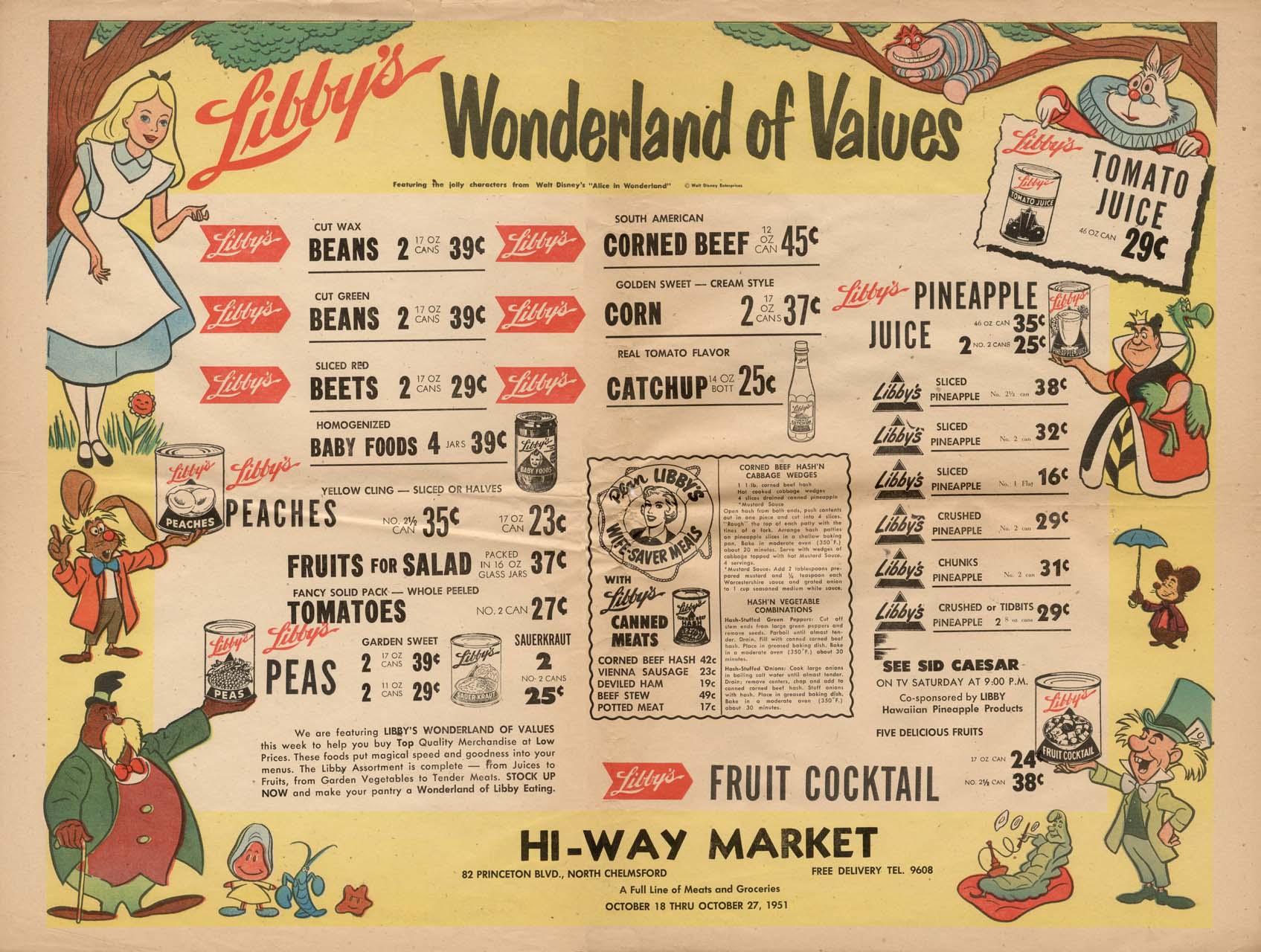
Libby's In-Store Broadside

Research continues for the book. Recently I acquired something I did not know existed, although I should have know since it is a common enough practice.

Most of you are probably aware of the HUGE tie-in campaign in 1951 by Libby, McNeill & Libby, commonly known as Libby's. They had a double page spread in Life magazine that I'm sure many of you have seen, and a big in-store display kit. But they also produced newspaper ads that I have seen in lots of local papers, there was probably an advertising kit too because I have found lots of local newspapers with unique ads, some even with full and double pages, featuring the characters.
But this was new. It is a double-page broadsheet, likely circular or newspaper ad, but only printed on one side, and used by the grocery store as an in-store ad, usually taped to the inside of a window for shoppers to see as they entered the store.


Could Libby's not decide which spelling to use, so they blended them into "CATCHUP"? Sound like a very tardy condiment indeed.

Friday, December 9, 2022

Australia Here We Come - Again!

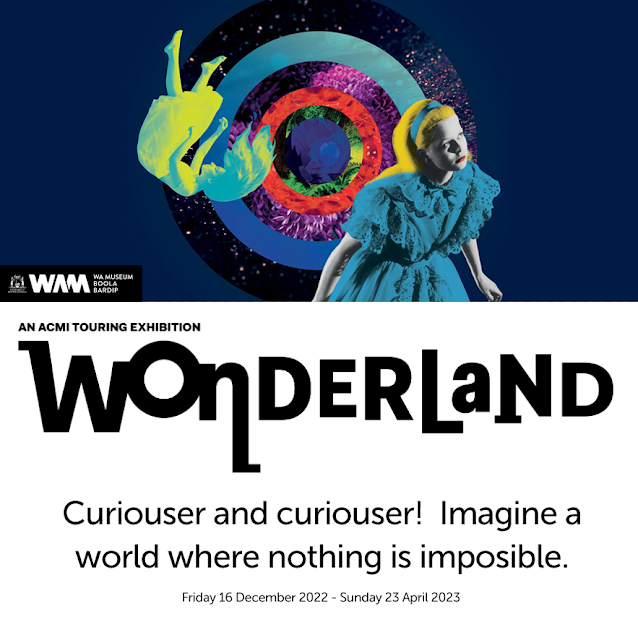
The ACMI Wonderland Exhibition tour is back on the road after a 2 1/2 year break due to COVID, and its next stop is Perth, Australia at the WA Museum Boola Bardip.  The lovely people at ACMI are again flying us down to help celebrate the opening and re-start of this amazing exhibition and its tour across the globe.  Any readers in Western Australia be sure to visit, and if you happen to be there December 15-18, introduce yourselves.  We'll be the two Americans wearing loud Alice-themed clothing ;-)


Sunday, August 28, 2022

Two Down, Thirteen To Go!

Well, I *think* I've hit another milestone today with the book.  I'm not sure, but I'm fairly certain I've completed the first draft of another chapter, that on Toys, Games, and Puzzles.  Time will tell (meaning once we get the collection back on display) whether or not I missed something, but I feel pretty good about it.  I may yet make my 2026 deadline!  This was a big one, 28 sections, but hey, gotta be complete :-)


Saturday, August 20, 2022

Banner Plastics Tea Set from 1955

Banner Plastics made a variety of plastic toys for children, but specialized in tea sets and toy trucks.

The Banner Plastic Corporation was founded in 1944 in the Bronx, NY by two men, Emanuel M. Pressner and Bernard Schiller, although Bernard Schiller would not stay long with the company.  In 1950, the company moved from the Bronx to Patterson, New Jersey where they purchase a former aeronautical engineering plant.  During the mid-1950s, the company greatly expanded its product line, adding new metal toys to complement their line of plastic toys, including tea set, blocks, and trucks.  Into the 1960s they continued to expand their tea set line to additional kitchen toys and dishes, licensing such brands as Pyrex, Corning Ware, and others.  They continued to acquire other toy companies further expanding their lines with garden toys, military toys, and space toys.  But by 1965 the company had contracted to the point that their catalog contained only 50 items, that catalog would be their last as they filed for bankruptcy that year, and by 1967 had been purchased by Tal-Cap, a large toy conglomerate in Minnesota.

Banner held a Disney license for only two years, between 1955 and 1956.  An ad from an issue of Playthings from April 1955 shows the Alice in Wonderland tea set, but in the picture is a plate with an image of Thumper, so it is likely that they made a few different tea sets, but to date I've not seen any other than the Alice set.  Tomart also lists stacking blocks and a Davy Crockett covered wagon, neither of which I am familiar with.

Items are marked Banner Plastics Corp., Paterson, NJ, and depending on the year and the package, may have the company logo featuring two kids waving banners.

The Alice in Wonderland tea set was released in 1955 at the beginning of Banner's Disney license, the Playthings ad from April clearly shows it (well, not that clearly but I've highlighted it in the second image).  


It is unclear why exactly they chose to do an Alice tea set, but there may have been renewed interest since the film had been aired on episode two of the Disneyland television show the previous November.  Also, the box in the collection features a label advertising the contest to win a trip to Disneyland, a promotion that ran the year prior to Disneyland's opening in July 1955.

No specific pricing for the Alice set has surfaced, but comparable sets of the era retailed at $3.98, which would be $40 in today's dollars.

The Banner tea set is amazingly cool.  For many years it was unclear exactly what was contained in this mythical toy, since only the tin pieces showed up the majority of the time.  However, the full tea set is actually pictured on the large tray so it was known what should have been included.  Eventually the plastic pieces surfaced, and later a full set in the original box was discovered.  A second set in the box was seen in the early 2000s and that is the set pictured here.


The tin pieces consist of four plates, four saucers, and the large tray.  The plastic pieces include four cups, four knives, four forks, four spoons, a creamer, a sugar bowl, a teapot, and a teapot stand - in loose sets the teapot stand is often missing.  Perhaps the coolest feature of the set is that all the handles are characters!


Tuesday, August 16, 2022

Trimfoot Shoes Alice in Wonderland Advertising Manual - The Alice Look!

Every once in a while something turns up that just completely blows me away.  This is one such item.  The complete advertising and promotional kit for Trimfoot Shoe's Alice in Wonderland campaign.

This thing is truly amazing, 16 pages plus cover and one insert of advertising gold for Trimfoot Shoes.  The campaign was called "The 'Alice' Look" and was centered around the marketing of a series of five different girls' shoes styles based on Alice.  
The manual contains sample ads, copy, artwork, you name it, for you and your local shoestore to maximize your "Alice" campaign.  It even pictures some Stensgaard displays that could be ordered to enhance your window treatments.
But the best part of course are the shoes, I especially love the "March Hare" with the ear-like appendages on the ankle strap.

Interestingly Trimfoot still exists, and although they don't appear to have a Disney license per se at this time, they do make some Marvel character shoes, so technically they are still a Disney licensee.  


Thursday, June 30, 2022

We Made Some Ink! Washingtonian Magazine July 2022

Being residents of the greater DMV (that's DC, Maryland, Virginia for those not in the know), the Washingtonian is our version of New York Magazine or Los Angeles Magazine, with features on local interest, published monthly.  And this month has a one-page feature on the Alice collection, only 6 years in the making!  Pictures below of the cover and our single page, and then an annotated page.


In the photo below, the numbered its are:
  1. Regal Mad Hatter Teapot
  2. Gund Queen of Hearts Vinylite Stuffed Toy
  3. Regal White Rabbit Creamer
  4. Zaccagnini (Italy) Cheshire Cat Figure
  5. Disneyland White Rabbit Press/VIP Gift from 1984 Attraction Re-Opening
  6. Neevel Doll Wardrobe Case
  7. Lars (Italy) Bill the Lizard Stuffed Toy
  8. 1970s Disneyland Child's Sunglasses
  9. National Leather Mfg Co Schoolbag
  10. Madame Alexander Doll
  11. Larceram (France) Lamp
  12. Chad Valley (England) Nursery Play-Toy Tin Stacking Blocks
  13. Unknown Tweedledee/dum String Holder (likely unlicensed)
  14. Enesco Head Vase
  15. Sni-Dor (Canada) Record Player
  16. Goebel (Germany) Dodo Smoker Ashtray
  17. Unknown (England) Meal Time Dish Set
  18. Hassenfeld Bros (Hasbro) Nurse Kit
  19. Linemar Mad Hatter's Sky-View Taxi Tin Friction Toy
  20. US Time Watch in Teacup Box


Sunday, June 19, 2022

Original Release Australian Press Book

Otherwise known in the US as campaign book, this press book contains lots of sample articles, ad mats, posters, and merchandise specific to the Australian market.  Super cool.  


The cover is based on the two-page ad that appeared in Look magazine here in the US, which was also issued as a promotional poster.  The same is true for this cover on the press book, it too was issued as a promotional poster.  


Both the press book cover and poster have slightly colors from the US, not sure if it is the printing method, or just similar fading over time, but they are decidedly more pink than the US versions.


One interesting this about this press book, and most Australian press books, is they way they are constructed.  It is multiple tabloid size sheets stapled together at the right edge, and folded in the center to look like a book or magazine - but since it is stapled at the edge, you have to unfold it before you can open it.


Perhaps the coolest part of the press book is the merchandise.  Many items are pictured, some of which have been posted about in years past here on the blog, but several I have never seen before nor even heard about.  Tea set anyone?  Yes please, I'll take ten!  And that boxed notepaper, to die for.  And not one, but two paint books!  Also mentioned but not pictured are an Alice doll and White Rabbit doll exclusive to the Australian market.  Wow.


And let us not forget the move posters, four of which are pictured.  Well, three posters and a glass slide.  We have all heard of the Australian daybill of course, posted about here, but I've never even heard of a 1-sheeter or 3-sheeter (presumably very similar to an american one-sheet and three-sheet).  And the glass slide was discovered not too long ago and posted here.


Tru-Vue

While stereographic (3-D) photography dates back nearly 200 years, it wasn’t until the introduction of Tru-Vue that the format became more streamlined and compact, as it utilized film rather than prints to create the stereo view.  Throughout the 1940s and 1950s subjects were primarily scenes of a travel-related or educational nature, although other scenes based on popular comic strips and comic books were available too such as Blondie, Buck Rogers, and Captain Marvel.  As  they continued to add more subjects geared towards children, titles expanded to include Disney, Howdy Doody, Red Ryder, and other western subjects.


In 1950 Tru-View began producing color films for the first time, partly in response to Sawyer’s competing View-Master product, which had been in color since its 1938 introduction.  The color process selected by Tru-Vue was Ansco, which at the time was more economical than Kodak and provided the needed color reproduction demanded by Ford Motor Company for its promotional film strips.  However Ansco color is not very stable and most films turned magenta over the years, the exception sometimes being cartoon subjects.


Tru-Vue acquired its Disney license in 1950 and held it through 1956.  At the time Tru-Vue was in the process of transitioning from black & white to color, so titles would sometimes appear in both formats. 
 

The Alice films were sold during the original release of the film in 1951, during not only the transition from black and white to color, but also from Tru-Vue’s Rock Island plant to Sawyer’s Beaverton plant.  When one compares the product information contained in the Character Merchandise Division catalog with the actual products themselves, you can see the transition as the company is list in Rock Island in promotional material but Beaverton on product packaging.  One can only imagine the the logistical nightmare of manufacturing, marketing, and selling Alice and all the other products during this time.


The black & white Film (B 51) was issued with the standard red and white box, the black and white film consists of ten scenes, down from the original 14 scenes in the pre-color days.  The films are a little difficult to look at these days, as the intervening 70+ years tightly wound in their little boxes makes them act like watch springs, recoiling violently with the slightest misstep in handling them.


The color film (X 51) was issued in the standard red, yellow, and blue box, the color film consists of the standard nine scenes.  

Both the black & white and color sets consist of the four sequentially numbered Disney films:  Alice in Wonderland (51), Bambi (52), Donald Duck (53), and Mickey Mouse (54) in an illustrated box featuring Donald Duck holding a Tru-Vue viewer.